
One of the questions I’ve been getting often since running Offbeat has nothing to do with L&D. It’s more along the lines of “how did you get to building your own thing?” I’ve been wanting to address this for a while, but I wasn’t ready to do it. I also wasn’t sure how to frame it. Because I didn’t want to talk about general entrepreneurship advice, but rather about the journey of a former internal L&D jumping to build my own business. While some general advice might be worth pursuing, operating in the learning and development industry isn’t the same as building something in product, marketing, or sales.
While I have plenty of thoughts to share from my last 4 and a half years of running Offbeat full-time, I’m well aware that I’m one person, based in Romania, serving L&D professionals. I knew other people from other countries, serving other audiences, doing coaching or training, might have different experiences. So I wanted to spend some time getting to know how others see their entrepreneurship and freelancing journeys before putting pen to paper, or better said, fingers to keyboard.
This piece is for anyone who’s actively thinking about going freelance, those who are doing it but have never spoken to others, and those who have no plans to do so, but are wondering what the grass looks like on the other side of the fence. It’s about my experience, but also about the journeys of eight more people I interviewed, and some others I’ve watched closely. It speaks about the technicalities, but also about the emotional journey of running your own show.
Deciding to go freelance — intentional or not?
I’ve always wanted to build something of my own. I don’t know exactly where I first got the idea, because nobody in my family had been an entrepreneur up until a few years back. It was just a desire to see something happen from nothing. So even before Offbeat, I had been actively pursuing small experiments alongside my full-time role. None of them ever led anywhere. Until 2020, when I started a series of LinkedIn posts that led to what today we call Offbeat.
Most of the people I interviewed had explored the idea of entrepreneurship as a path for them. Jess Almlie thought it would be something she’d do before she retires. Klara Hermesz bought a domain years before quitting. But haven’t we all thought about it at some point? Millennials and Gen Zs grew up with what Chris Wong calls a “romanticized view of working for yourself,” with stories of successful founders and following influencers who seem to have the freedom all of us think we want.
When put in front of the decision to go freelance, though, most of us get antsy. I know I did. It took me months to decide whether I would actually do it or not. I remember telling my then manager that I’m quitting and spending months wondering, “What the hell am I doing, leaving a good job, a nice team, and a steady paycheck behind to pursue a dream?”
Lo and behold, that’s not everyone’s story. Quite a few of those I interviewed came face to face with the decision of going freelance after they lost their job during layoffs or when their employer decided to do some restructuring. When faced with that situation, Liam Moore started looking for a new role. But after becoming disillusioned with the job market, he decided to do some coaching as interim work until he found another role. Slowly, he gave up on the idea of ever going in-house again, and focused on building his coaching and supervision practice. After an acquisition, Jess found herself offered a role she didn’t particularly enjoy, so she went on interviewing for other companies. In some cases, she didn’t get through to getting the job, while in others she decided it would be better to step out of the recruitment process when she better understood what she would be dealing with. After a while, she took time to workshop her options on her own, answered all the career questions she could find online, and upon reflection she realized her next step wasn’t going to be another corporate role.
Regardless of what triggered the decision, the main thing that kept everyone up at night was, unsurprisingly, the financial pressure. Some jumped into the journey with some sort of financial cushion from savings or a severance. Others, like those I spoke to from the US, had to think about health insurance as well (health coverage in the US comes through an employer). Many had serious conversations with their partners and spouses, and even consulted financial advisors.
Tom McDowall, who started his journey with Evolve in 2018, is the only one who had a slightly different view of the financial pressures you deal with at the beginning of such a journey. Out of all the peers I spoke with, he’s the only one who took this seriously pre-2020, when things were looking slightly different, and demand for services in L&D was higher. But even he mentioned that having a 6-month financial cushion today is important, given times have changed.
The advice that stood out to me came from Jess Almlie. Regardless of your path of choice, networking and putting yourself out there as early as you can is an important contributor to a later decision. Being part of communities like Offbeat or L&D Shakers, posting on LinkedIn or Substack, and joining local or online events brings you support for your current role, but can also lower the pressure later on if you decide to go freelance. Jess started her newsletter and posting regularly on LinkedIn about a year or so before starting her business. I ran Offbeat for almost two years before quitting my job. While none of it guarantees any success, it can make the landing smoother.
Mayday, mayday, the start is more confusing than expected
It’s your first Monday working full-time as a freelancer. What should you do? Build a website? Do outreach? Figure out your offering? Figure out your taxes? All of the above? Something else?
The answer is never straightforward because it all depends on what your previous efforts have looked like. Offbeat was already incorporated, I had an accountant, and had a steady presence on LinkedIn when I first started working on my own. Truth be told, I can’t even fully remember what my focus was at first, but my guess is that I started thinking about our offering. I was relatively clear about the problem we were trying to solve, which was that L&D teams are not being relevant in their organizations, but I was still unclear about what our solution was. Four years in, people are still unsure about what we do at Offbeat, so we still have a lot of work to do to clarify our offering.
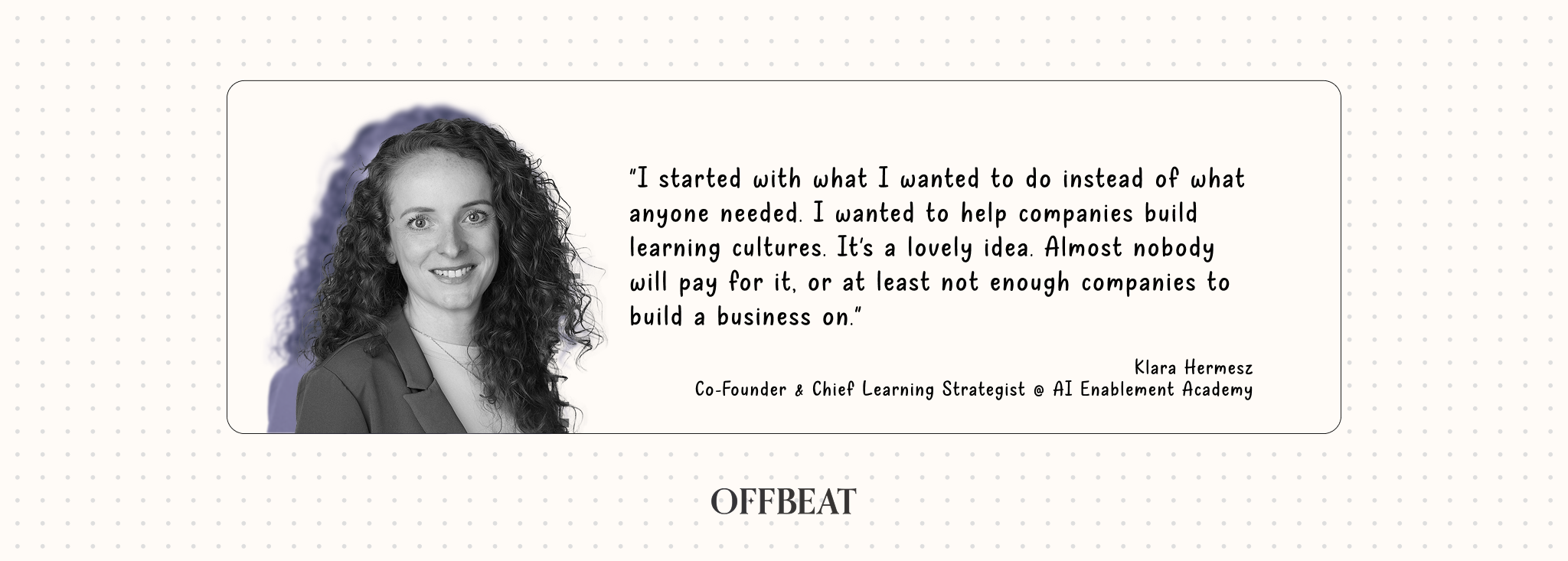
But something Klara mentioned stayed with me. Something she feels she got wrong at first was that she “started with what I wanted to do instead of what anyone needed. I wanted to help companies build learning cultures. It's a lovely idea. Almost nobody will pay for it, or at least not enough companies to build a business on.” The positive side of the story is that she didn’t stay attached to the idea for long. She offered a free week of consulting, piloted a few workshop ideas, and paid attention to what people actually responded to. None of it pointed back to learning cultures. It pointed to AI adoption, something she was already investigating herself, and what she ended up doing after all.
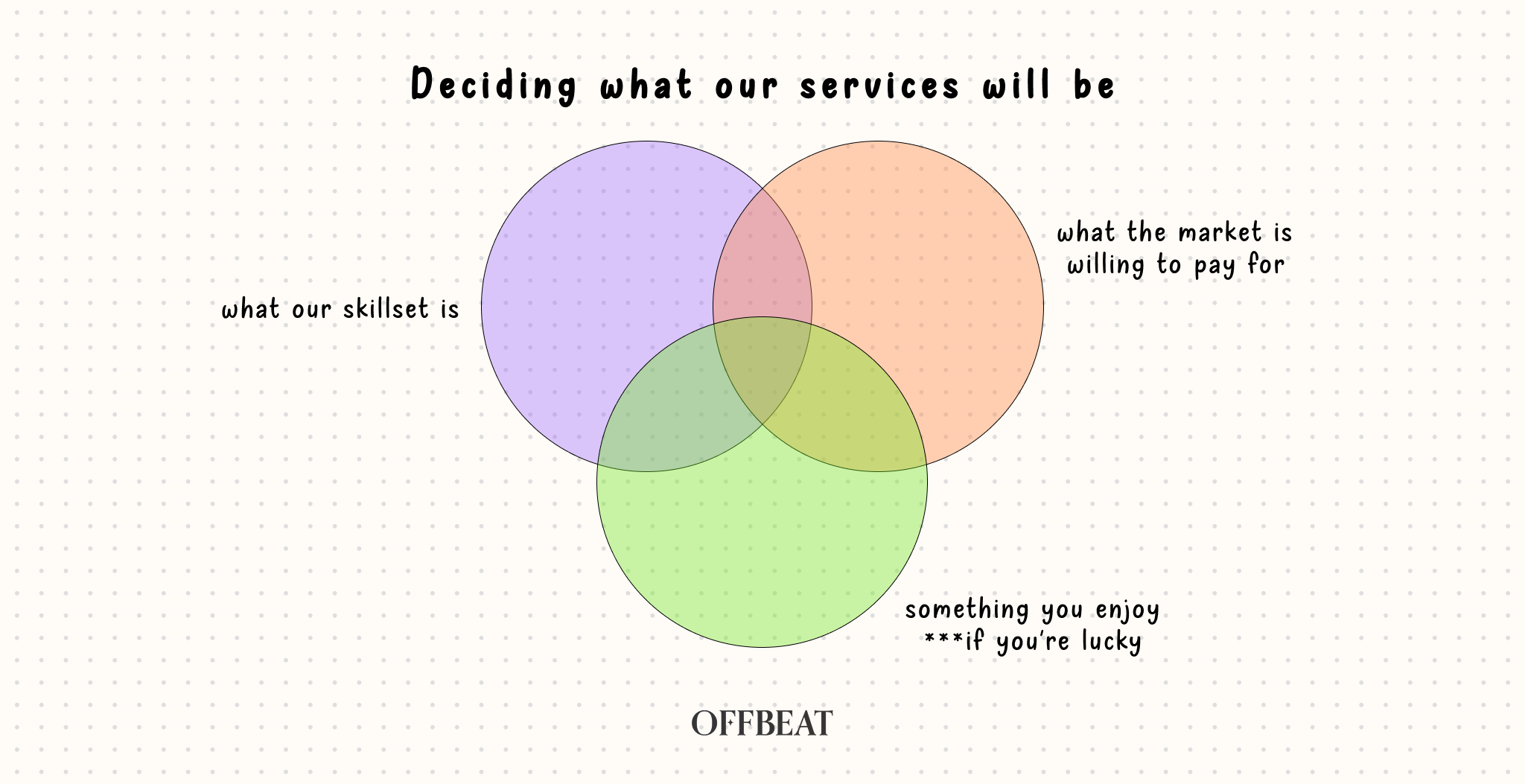
A lot of the work you’ll have to do at first will be figuring out what exactly you will be paid for. While it would be fantastic for the process to be one and done, the reality is messier and way longer. What one client will pay for might not be the same as what another client is willing to invest in. In L&D, we usually come with a range of possibilities. We can run training or consult on various areas like leadership development, onboarding, succession planning, or learning experience design, among others. We can do coaching if we’re certified. We can facilitate. We can create e-learning. We can support AI transformation. And we can even plan events. Deciding what our services will be is a combination of what our skill set is, but also, just like Klara mentioned, what the market is willing to pay for. If the two converge to be something you also enjoy, that’s fantastic, though not always the case.
Not enjoying the work is a big risk for anyone who will start freelancing in L&D. When you’re just starting out, you might not get the most glamorous projects, so there’s a real chance you’ll quickly burn out. Paired with the fact that figuring out what companies can pay for takes time, the initial weeks can feel confusing and overwhelming.
Oftentimes, to counter that confusion, we fill our time with something we can control, like building a portfolio or designing our website. Tom McDowall mentions this is the advice everyone hates, but he truly doesn’t believe this is where the focus of a new freelancer should be. Dwayne Britton brought up a similar point. Having been part of organizations where beautifully designed assets were a must, he also felt pressured at first to spend a lot of time designing his website, only to later realize there are better things to do. Jess Almlie built a one-pager in Wix herself, without putting too much pressure on it. It took her more than a year before she felt the need to invest in something more professional.
My own experience says that clarity is the most important point of any marketing asset you’ll build. When you’re not sure whether what you offer will actually make money, you’ll lose time designing and redesigning your beautiful website or portfolio. And that time can be spent in better ways.
.svg)
.png)
.png)
.png)
.png)