L&D QUESTIONS

The In-Depth Guide to Deploying Team Development Programs

Adam Ambrozy
March 2, 2026

If the nature of your work is deeply individual, this guide might not be for you. But if you work in teams, with teams, or expect people to collaborate effectively, this can help you build something extraordinary.

Teams that work with intention can improve their collective performance by 30–50% within 6 months, based on MakeTeamWork’s measurements from global programs. If you form project teams, channel the energy into team formation to ensure strategic alignment from the start.

This guide is for L&D professionals - facilitators, coaches, and learning designers, who want to introduce team development as an ongoing rhythm rather than a one-off event. It’s a practical, iterative field guide - designed for experimentation, reflection, and adaptation.

Mindset: Iterative and Adaptive

Forget the idea of a perfect design. Instead, think like a scientist:

  • Start small
  • Test in real team environments
  • Gather feedback
  • Adjust the format
  • Scale what works

Before you start: Reflect on whether it’s for you

  1. Do you create long-term or project teams? This guide addresses the first context. 
  2. Are people in your teams interdependent (collaborating on tasks) or work as independent contributors? If people work independently and there’s no space for teamwork, then there’s no point in developing teams. 

Where to start: Preparing the Ground
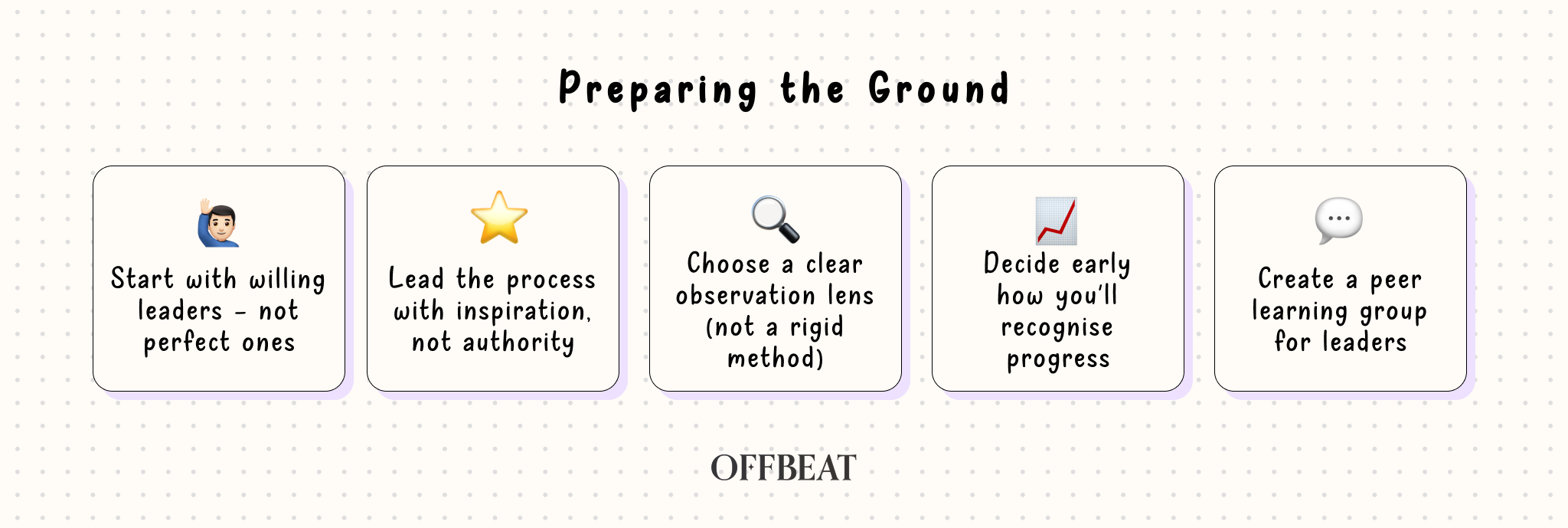
1. Start with willing leaders - not perfect ones

Begin by identifying leaders who are curious about improving how their teams work, not necessarily those who claim to have problems. In practice, many leaders sense that more is possible, say that teams should work better, yet still believe they personally are “already doing their best.” The pattern is familiar: “Everyone needs this… just not me.”

Treat this not as resistance, but as a natural defence mechanism. Team development touches identity, not just skills.
Your job at the start is not to convince - it’s to create a safe invitation.

2. Lead the process with inspiration, not authority

Team leaders tend to trust experience more than theory. If you are not a senior leader yourself, avoid positioning yourself as a “truth-giver” or expert judge. That role is difficult to sustain and easy to resist.

Instead:

  • Share stories, patterns, and observations
  • Ask reflective questions
  • Position yourself as a learning facilitator, not a validator

Trust grows faster when leaders feel respected, not evaluated.

3. Choose a clear observation lens (not a rigid method)

Educate yourself and be explicit about the frameworks you will use to observe and reflect, not to diagnose or label.

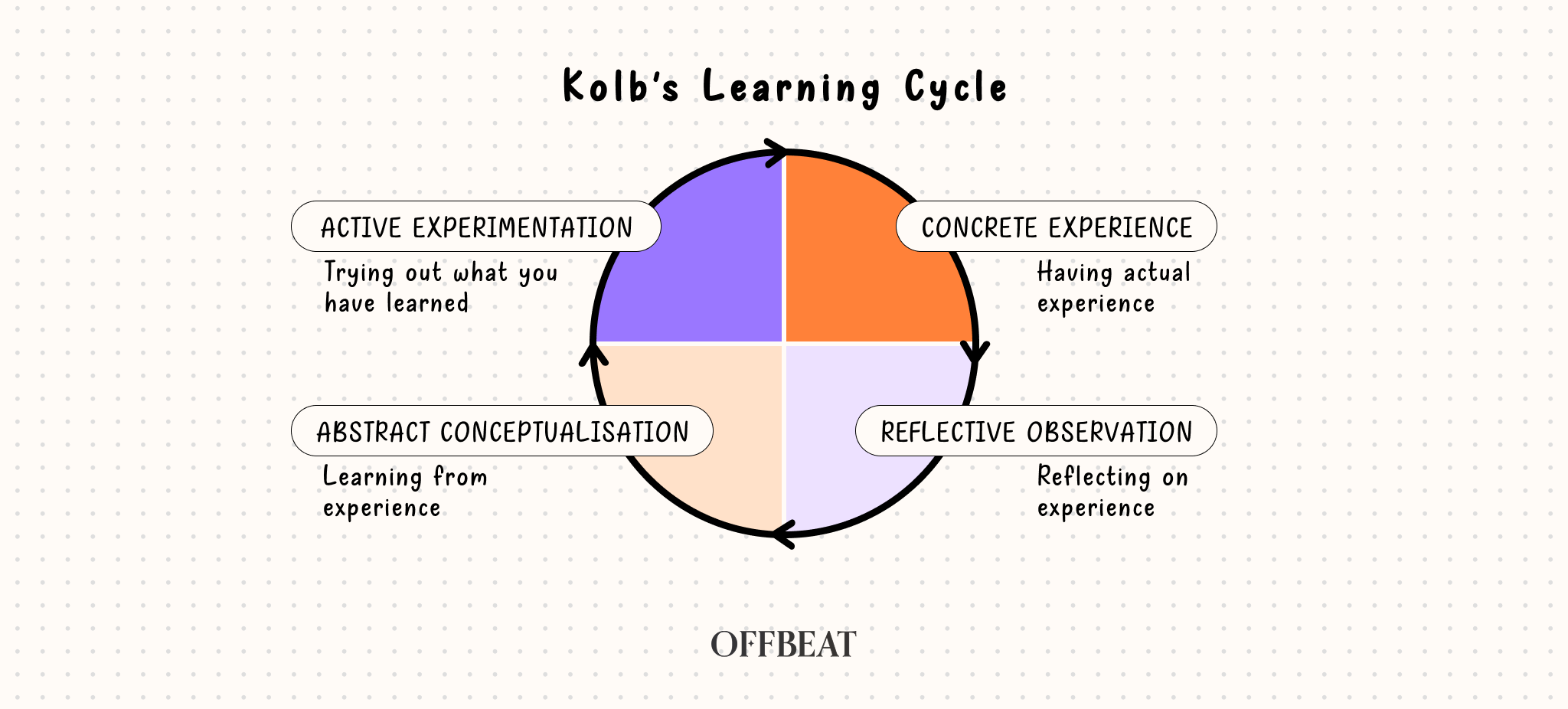
Three models work particularly well together:

You may bring all three into reflection conversations, not as explanations, but as mirrors teams can look into. The design of the mix is up to you - choose what intuitively makes sense as a starting point, and then tweak whenever necessary.

Additionally, many organisations find strong value in insights from Project Aristotle, especially when combined with Amy Edmondson’s work on psychological safety. This lens alone can support meaningful team reflection, questions, and examples are widely available, including in Amy’s book The Fearless Organization.

4. Decide early how you’ll recognize progress

Before running any sessions, align on what “better teamwork” means in practice.
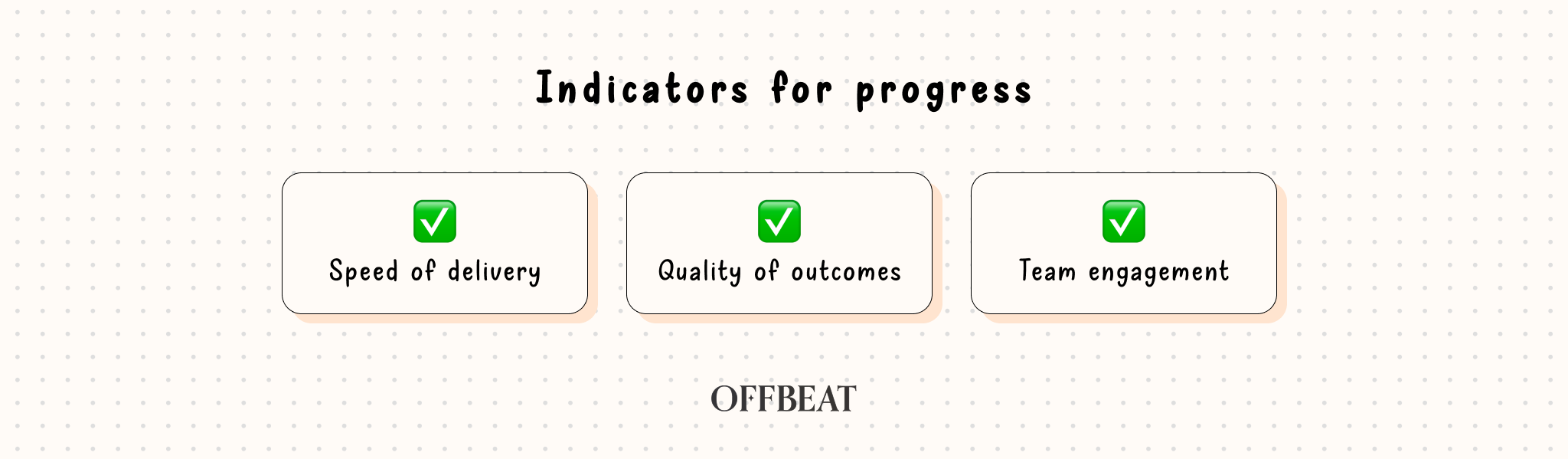
Across organisations, three indicators are most commonly used and understood:

  • Speed of delivery – how quickly teams move from idea to outcome
  • Quality of outcomes – fewer reworks, clearer decisions, better handovers
  • Team engagement 

These indicators are best used as signals, not targets.

5. Create a peer learning group for leaders

One of the most effective accelerators is a leader learning group - a small, recurring forum where leaders:

  • Share what they are trying with their teams
  • Reflect on what worked and what didn’t
  • Learn from peers and field practitioners

This normalizes experimentation and removes the pressure to “get it right.” In many cases, peer learning becomes more impactful than any formal training.

In short: Start small. Start with trust. Create a reflection before intervention. And let leaders learn with each other, not from you.

What kind of questions should I ask?

Start by co-creating the focus with leaders who are genuinely interested in growing. Team reflection works best when participation is voluntary, not assigned. Leaders who opt in bring openness, curiosity, and psychological safety, all of which matter more than perfectly worded questions.

Rather than inventing questions from scratch, let the models guide you. The frameworks you chose earlier (e.g., Lencioni, Wheelan, …) naturally point to the right areas of inquiry. 

Practical guidance:

  • Use questions derived from established models.
  • Source them from the original books, practitioner toolkits, or existing diagnostics - you can ask AI to help you find them.
  • Adapt the wording to your organizational and cultural context - the intent of the question matters more than its phrasing.

The goal is not to run an assessment, but to spark honest reflection and learning. Well-chosen questions open conversations teams rarely make time for, and that’s where progress begins.

What process should I design and follow?

Think of the process as a learning experiment, not a rollout. Your role is to create just enough structure to support and facilitate reflection, trust, and continuity, and no more.
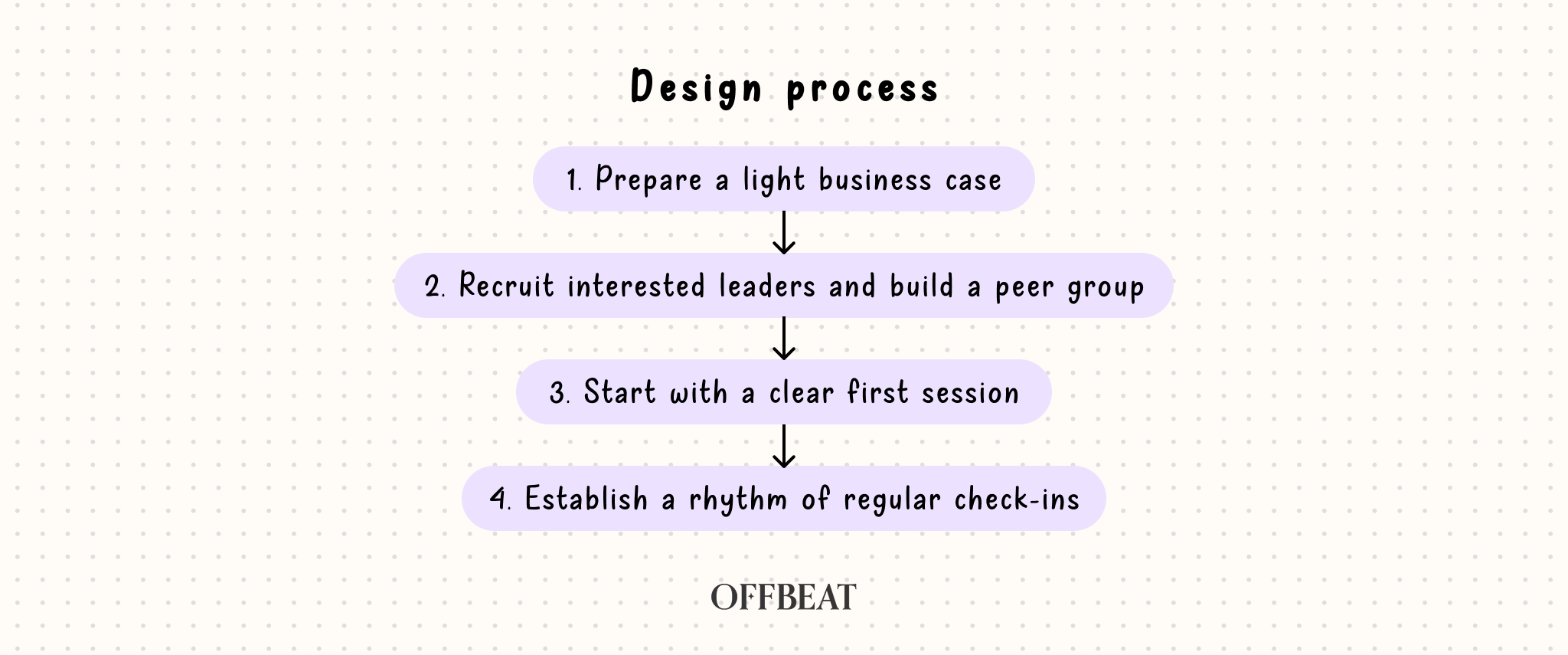
1. Prepare a light business case

Start small and practical. Rather than selling a full program, invite leaders to experiment. Frame the initiative as a low-risk way to improve collaboration, decision-making, and delivery, not as a corrective intervention.

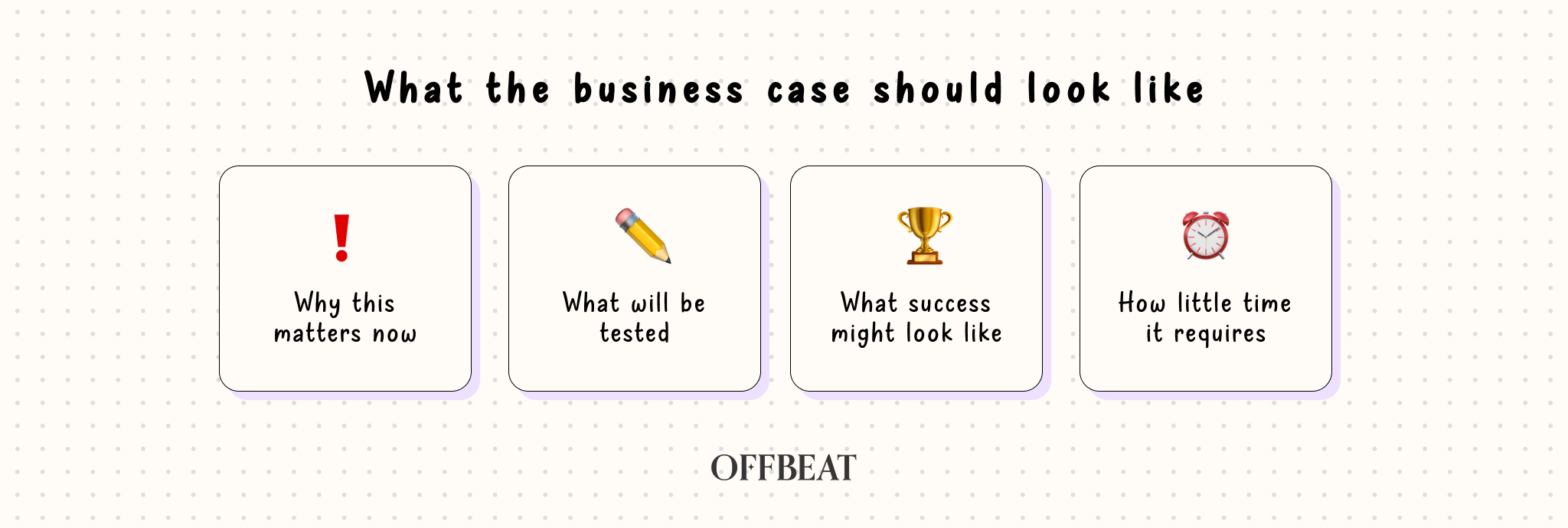
Keep the case simple:

  • Why this matters now
  • What will be tested
  • What success might look like
  • How little time it requires

Curiosity and relevance will attract more engagement than ambition.

2. Recruit interested leaders and build a peer group

Invite intrinsically motivated leaders to improve how their teams work. Voluntary participation is essential as it creates psychological safety and sets the tone for learning.

Bring these leaders together into a peer support group:

  • A space to share experiences
  • Reflect on what they’re trying
  • Learn from each other’s challenges and insights

This group becomes the engine of learning and momentum.

3. Start with a clear first session

Use the first meeting to:

  • Clarify the purpose of the experiment
  • Set shared expectations
  • Agree on principles (confidentiality, openness, experimentation)
  • Introduce the reflection models you’ll use

Avoid overloading the session - the leaders’ perspectives matter more than your content.

4. Establish a rhythm of regular check-ins

Sustainable change comes from rhythm, not intensity.
Set up short, recurring check-ins (e.g., every 4–6 weeks) to:

  • Reflect on what leaders tried with their teams
  • Surface patterns across teams
  • Adjust the approach together

Consistency turns isolated efforts into a learning system.

In short: Start small. Invite, don’t impose. Create peer learning. And let regular reflection do the heavy lifting.
Subscribe to Offbeat

Every Sunday we send over a pack of articles, e-books, podcasts, videos, and thoughts, to inspire you and help you stay up to date with what's happening within our L&D community

Awesome! Now, check your inbox
Oops! Something went wrong while submitting the form.

How do I convince my manager or internal stakeholder to get started?

The goal is not to win an argument but to reduce perceived risk and make starting feel sensible, safe, and worthwhile.

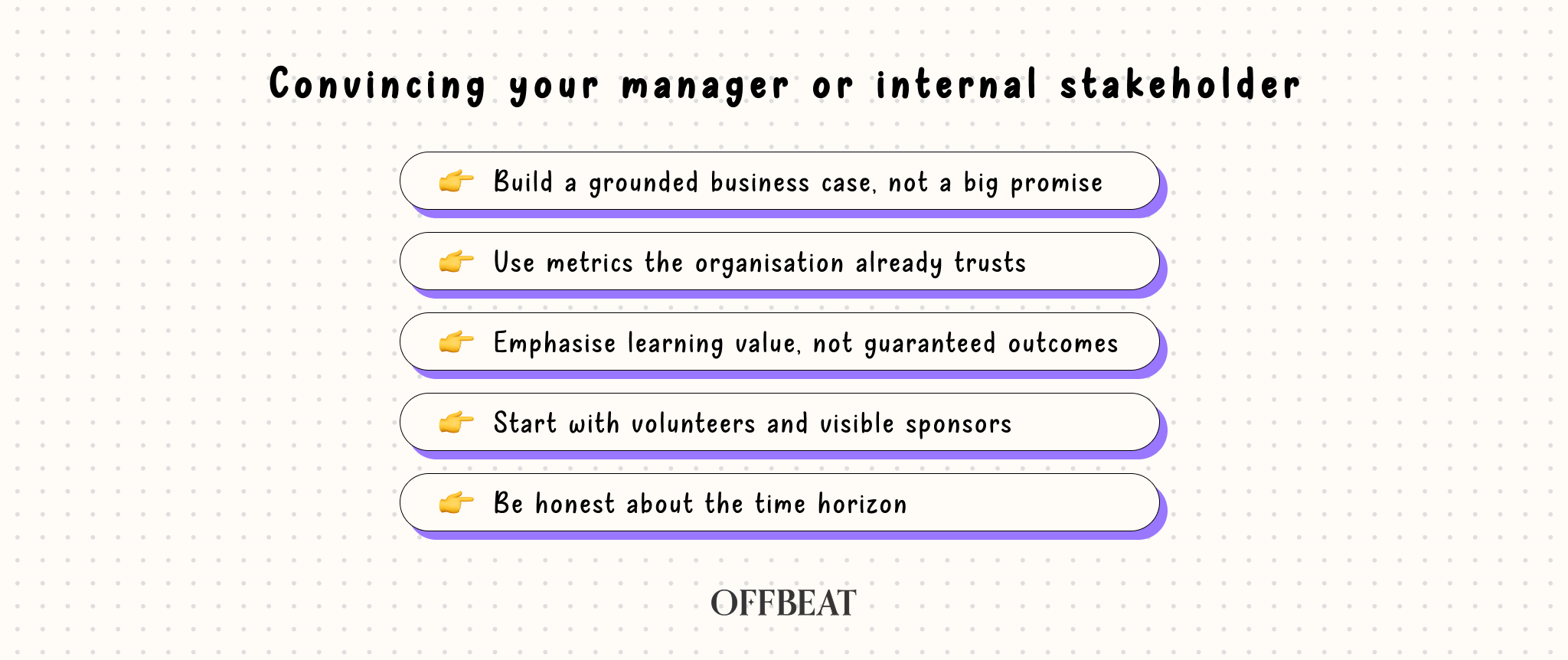
1. Build a grounded business case, not a big promise

Avoid selling “team development” as a transformation initiative. Instead, position it as a small, time-bound experiment focused on improving how work gets done.

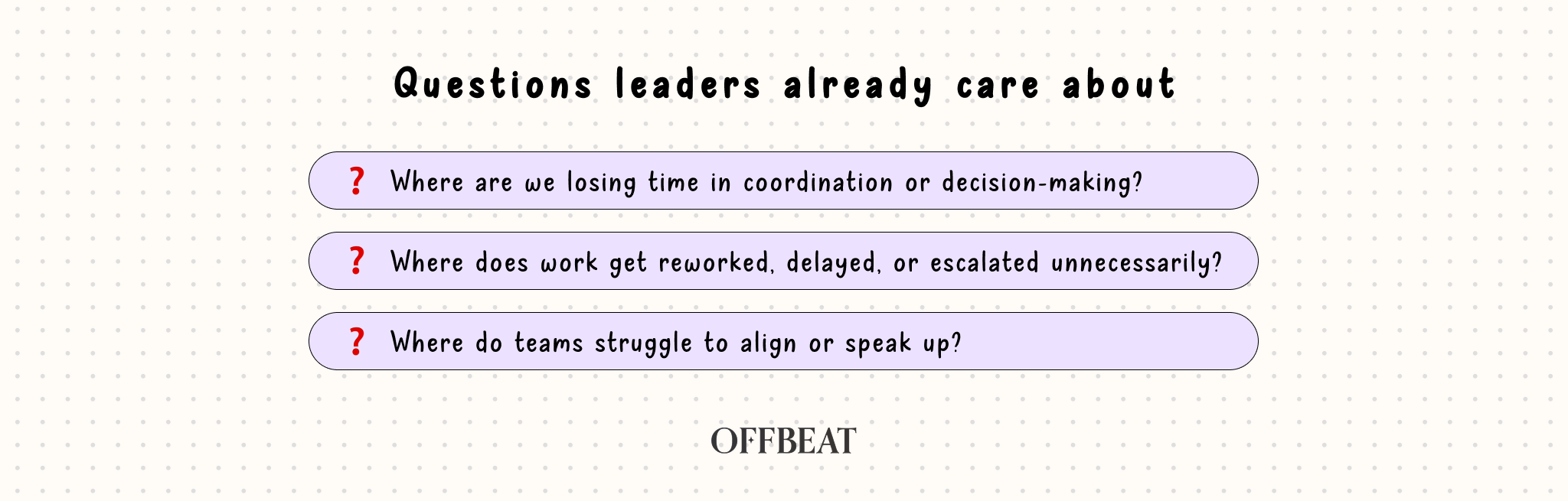
Anchor your case in questions leaders already care about:

  • Where are we losing time in coordination or decision-making?
  • Where does work get reworked, delayed, or escalated unnecessarily?
  • Where do teams struggle to align or speak up?

Frame the initiative as a way to learn about these patterns, not to fix everything at once.

2. Use metrics the organisation already trusts

Wherever possible, reuse existing measures rather than introducing new ones. This lowers resistance and makes progress easier to recognise.

Commonly accepted indicators include:

  • Speed of delivery (cycle time, throughput, time to decision)
  • Quality of outcomes (rework, defects, clarity of handovers)
  • Team engagement (pulse surveys, attrition risk, participation)

Be explicit that these metrics will show directional change, not instant results. High-performing teams deliver better and faster, but building them takes time.

3. Emphasise learning value, not guaranteed outcomes

Leaders are often wary of initiatives that promise results without certainty. Position this work as a learning investment:

  • Low cost
  • Limited time commitment
  • Clear reflection points
  • Option to stop or adapt at any time

This makes it easier for a manager to say “yes” without needing full conviction.

4. Start with volunteers and visible sponsors

Explain that the first phase will involve leaders who opt in, not a broad rollout. This reduces political risk and allows you to generate credible internal stories.

If possible, secure a respected leader as a visible sponsor, someone whose participation signals seriousness without forcing compliance.

5. Be honest about the time horizon

Avoid overselling speed. Make it clear that:

  • Team effectiveness compounds over time
  • Early signals may appear within weeks
  • Meaningful, sustained impact typically unfolds over months

This honesty builds trust and prevents disappointment later.

In short: Convince by making it small, relevant, and safe to try. Reuse what already exists. Promise learning, not miracles.

How do I make sure this doesn’t become overwhelming?

The biggest risk in team development is not resistance, but overload. People don’t push back because reflection isn’t useful; they push back because it feels like “one more thing.”

Your design principle should be simple: build a habit of reflection, not a heavy intervention.

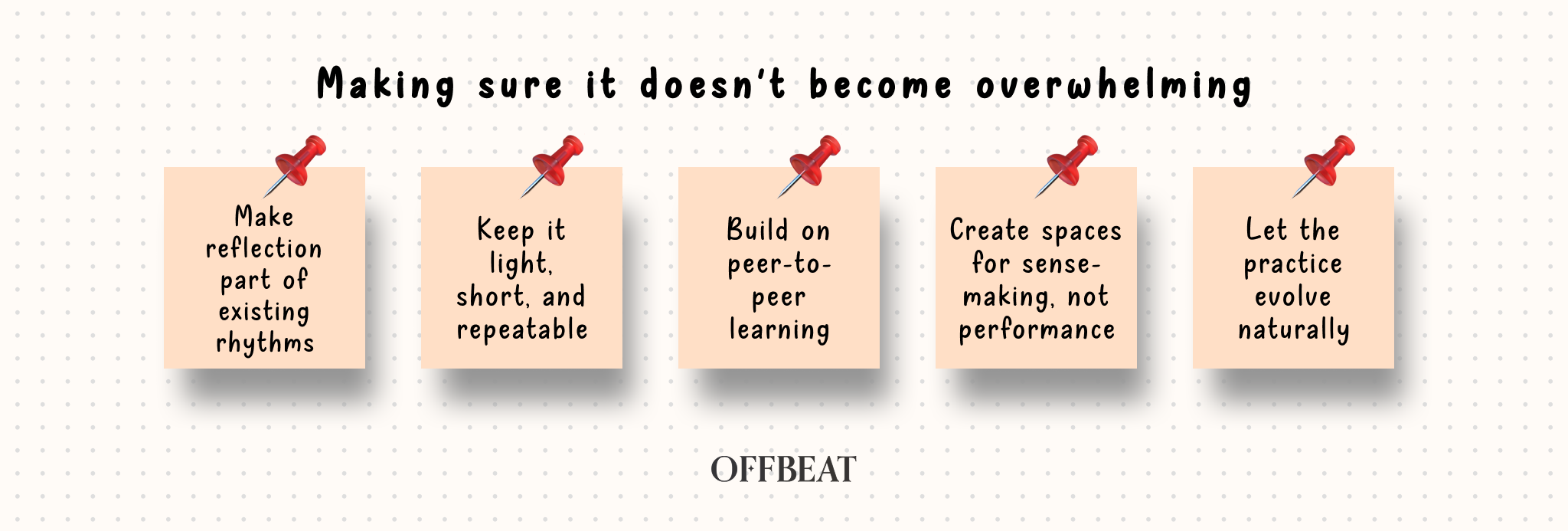
1. Make reflection part of existing rhythms

Avoid introducing new meetings wherever possible. Instead, embed reflection into what already exists, for example:

  • Add a short reflection segment to regular retrospectives
  • Close recurring meetings with one reflective question
  • Use check-ins already present in the workflow

This signals that reflection is how work gets done, not an extra layer on top.

2. Keep it light, short, and repeatable

Consistency matters more than depth. Short, focused reflections done regularly are far more effective than long, intensive sessions done occasionally.

Practical guidelines:

  • 30-60 minutes is often enough
  • Focus on one question/topic at a time
  • End with one small insight or adjustment

This lowers emotional and cognitive load while still creating movement.

3. Build on peer-to-peer learning

Nothing reduces pressure like learning together. Peer settings allow people to:

  • Compare experiences
  • Normalise struggles
  • Learn what others are trying
  • Vent safely without needing solutions

Importantly, this is not about teaching or fixing - it’s about reflecting and making sense of experience together.

People trust peers more than frameworks, and stories more than advice.

4. Create spaces for sense-making, not performance

Make it explicit that these moments are:

  • Not evaluations
  • Not status updates
  • Not problem-solving sessions

They are spaces to pause, reflect, vent, and reconnect, which often releases more energy than it consumes.

When people feel they don’t need to perform, reflection becomes energising rather than draining.

5. Let the practice evolve naturally

Resist the urge to standardise too early.
Allow teams and peer groups to:

  • Adjust the format
  • Tweak questions
  • Shorten or lengthen sessions

Ownership reduces fatigue. When people shape the practice themselves, it stops feeling imposed.

In short: Blend reflection into existing routines. Keep it small and human. Let peers learn from peers.

When reflection becomes a habit rather than an event, it supports people instead of exhausting them.

How can I scale it (especially with a small L&D team)?

Scaling team development isn’t about doing more. It’s about designing a system that can run with less dependence on you over time.

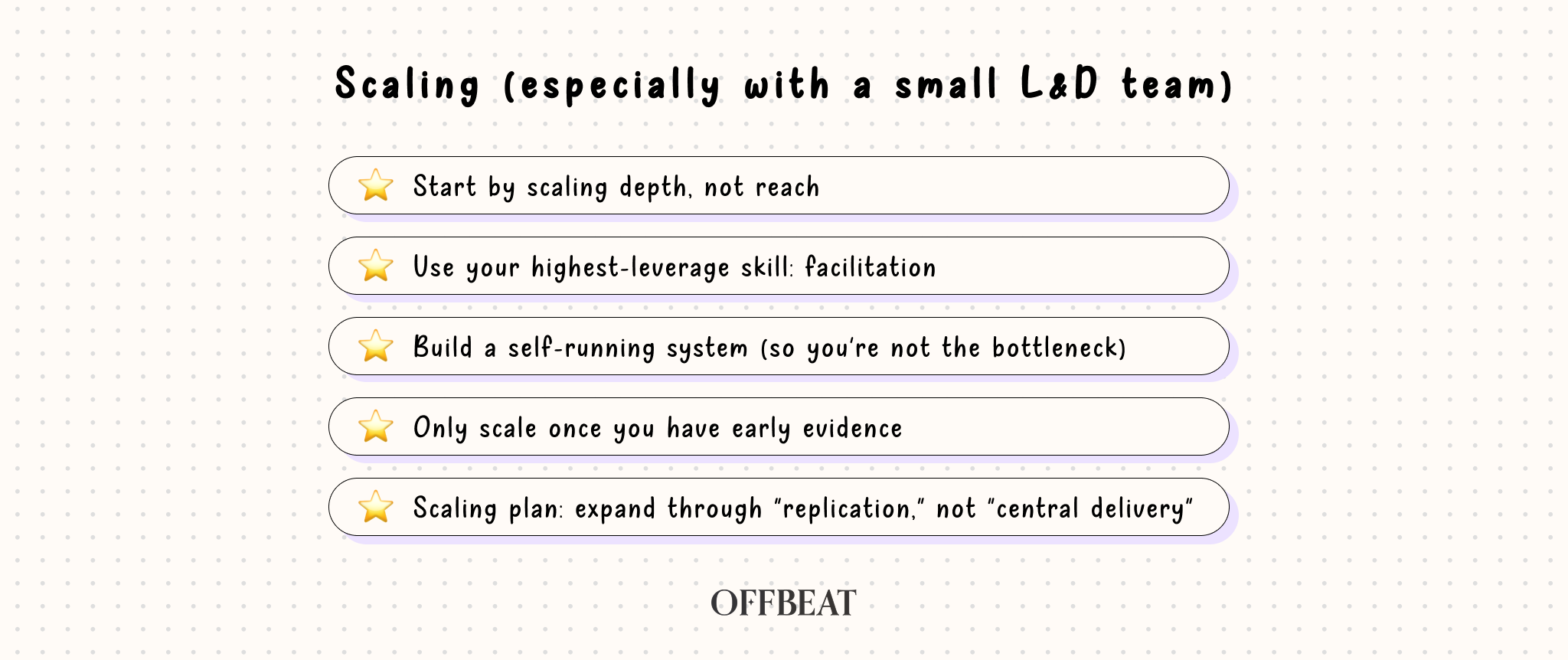
1. Start by scaling depth, not reach

In the beginning, don’t aim for “many teams.” Aim for a few teams with visible results. Team development is not instant - even when things go well, meaningful improvement typically shows up after a few months of consistent reflection and experiments.

So the first rule of scaling is: don’t scale before you can explain what’s working and why.

2. Use your highest-leverage skill: facilitation

As a small L&D team, you won’t be able to coach every team weekly, and you don’t need to.

A scalable role for L&D is to:

  • Facilitate monthly or bi-weekly team retrospectives (or help teams run them themselves)
  • Provide a simple structure for reflection and experiments
  • Create a repeatable “session kit” that leaders can reuse

Think of yourself as the architect of the rhythm, not the owner of every session.

3. Build a self-running system (so you’re not the bottleneck)

Scale happens when the work is distributed. Two practical moves help:

  • Leader peer learning group: leaders learn from each other, not only from you
  • Volunteer team developers inside teams: a small number of motivated people help run reflection and track experiments

This turns team development into a community practice, not an L&D service queue.

4. Only scale once you have early evidence

Before expanding, capture:

  • What you did (format + frequency)
  • What changed (signals, outcomes, stories)
  • What enabled success (conditions, leadership behaviours, context)

This becomes your internal case: simple, credible, and repeatable.

A good scaling trigger is:

  • 2–3 teams completing 2–3 cycles of reflection + experiments
  • Clear qualitative signals (trust, clarity, speed, fewer escalations)
  • At least one metric moving in the right direction

5. Scaling plan: expand through “replication,” not “central delivery”

Once you have proof, scale via:

  • Templates and facilitation guides
  • Train-the-leader micro-sessions
  • Shared measurement approach
  • Community of practice and monthly touchpoints

That’s how a small L&D team can support many teams without burning out.

Closing: The role of L&D in this work

L&D does not need to own teams in order to support how teams work. But L&D can, and should, own the process that enables learning, reflection, and continuous improvement across teams.

This role is not one of power or prescription. It is a role of inspiration, facilitation, stewardship, and design.

L&D creates the conditions:

  • where leaders feel safe to reflect rather than defend,
  • where teams can pause without losing momentum,
  • where learning happens in the flow of work, not outside it.

The strength of this approach lies in its adaptability. There is no single “right” format, cadence, or question set. The most effective designs will emerge from:

  • your understanding of the organisational context,
  • your intuition as a facilitator,
  • and your willingness to listen, adjust, and evolve the practice over time.

Trust your intuition. Use structure as a support, not a constraint.

When L&D leads in this way, quietly, consistently, and with curiosity, team development stops being a program and becomes a shared habit. And that is where lasting performance, engagement, and learning truly grow. Good luck!

Adam Ambrozy

Helping leaders turn complexity into clarity, decisions, and action through co-creation at MakeTeamWork

Meet Offbeat

We’re the place where L&D professionals accelerate their career. Live programs, mentorship, lots of practice and knowledge sharing.

A diverse learning community

Curated learning resources

Personalized guidance in your learning journey

Weekly live sessions

Cohort-Based Programs run by experts

1:1 mentoring relationships

Become an Offbeat Fellow →

Copyright Offbeat 2023